

The New Stadium Effect Is Structural, Not Temporary
Evidence from 26 stadium relocations in English football shows sustained attendance growth over two decades

Introduction
Across 26 stadium relocations in English Professional Football, average attendances increased materially and remained elevated well beyond the first decade after a move.
This evidence points not to a temporary “New Stadium Effect”, but to the release of previously constrained demand and a structural reset in a club’s long-term strategic position.
Key Results
Average attendances increased by 74% in the first decade following a stadium move;
The uplift was sustained into a second decade: for the 15 clubs with 20-year histories, attendances remained 91% higher;
Stadiums were just 58% full prior to relocation, with only five clubs achieving occupancy of 80% or more in the last 10 years in their previous ground;
Clubs improved by an average of 8 league places following relocation, but there was a wide range of outcomes.
Interpretation
Taken together, these results indicate that growth is driven by the release of latent demand as the constraints of older grounds are removed. Several clubs with grounds operating at below 50% occupancy went on to deliver two to three times higher attendances in their new stadiums.
This reflects how the removal of constraints at older grounds unlocks new supporter segments – including families, more casual supporters, and materially expanded hospitality – driving a structural and sustained increase in matchday revenue.
Beyond attendance growth, new stadiums materially enhance a club’s attractiveness, brand strength, and commercial capacity – expanding existing inventory, creating new revenue opportunities, and increasing the ability to attract further investment.
Taken together, these effects can support improved on-pitch performance – clubs improved by an average of eight league places – while fundamentally resetting a club’s long-term strategic position, reinforcing that in English football the “New Stadium Effect” reflects a structural shift rather than a temporary uplift.
The “New Stadium Effect”
In US sports, Bradbury (2024) finds that new stadiums generate a temporary increase in attendance that diminishes within a decade of opening.
By contrast, Van Ours (2024) shows that in Dutch football, attendance gains following stadium relocations are sustained and, for many new stadiums, persist over time. This is consistent with the removal of binding infrastructure constraints in an open system with promotion and relegation.
The evidence presented here supports and extends the latter view.
Context and sample
Since 1993, 33 new stadiums have opened across English professional football, adding approximately 850,000 modern seats.
This expansion followed four decades of stagnation, during which just six new stadiums were built and league attendances declined by 63% between 1948/49 and 1985/86, driven by deteriorating matchday experience, outdated infrastructure, and wider safety concerns.
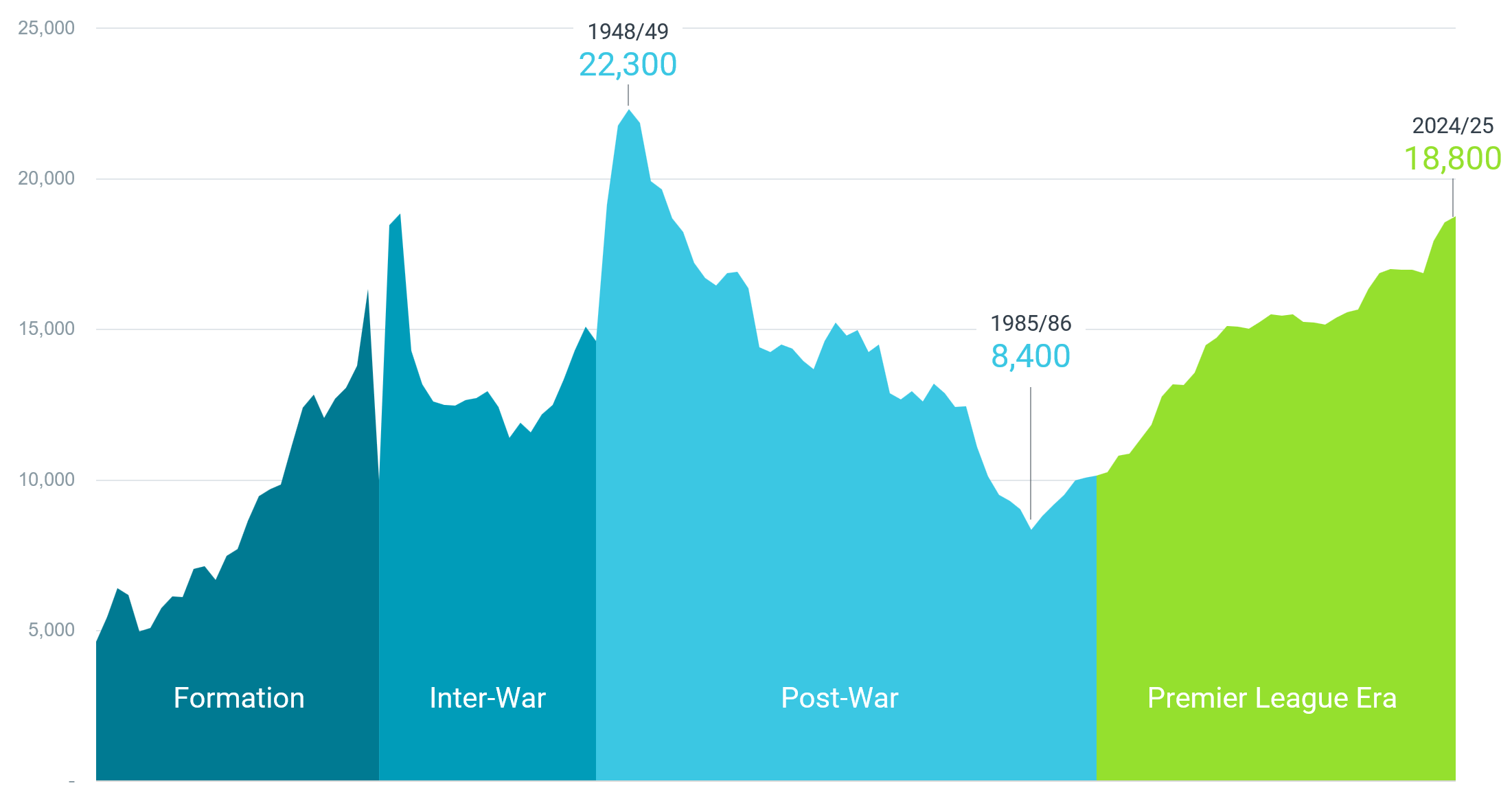
Since then, as part of this modernisation, new stadiums have been the primary route to delivering significant capacity increases. Of increases of 10,000 seats or more since the start of the Premier League, 11 have been delivered through relocation, compared with five through redevelopment.
Of the 33 new stadiums built in this period, 26 have been open for at least ten years and 15 for 20 years or more, forming the basis for the following analysis.
#1 Attendance growth is significant, and sustained
Average attendances increased by 74% in the first decade after a stadium move, compared with the final ten years at the previous ground. Growth was sustained across the decade, with annual increases of 70–85% and no indication of a temporary uplift or weakening over time.
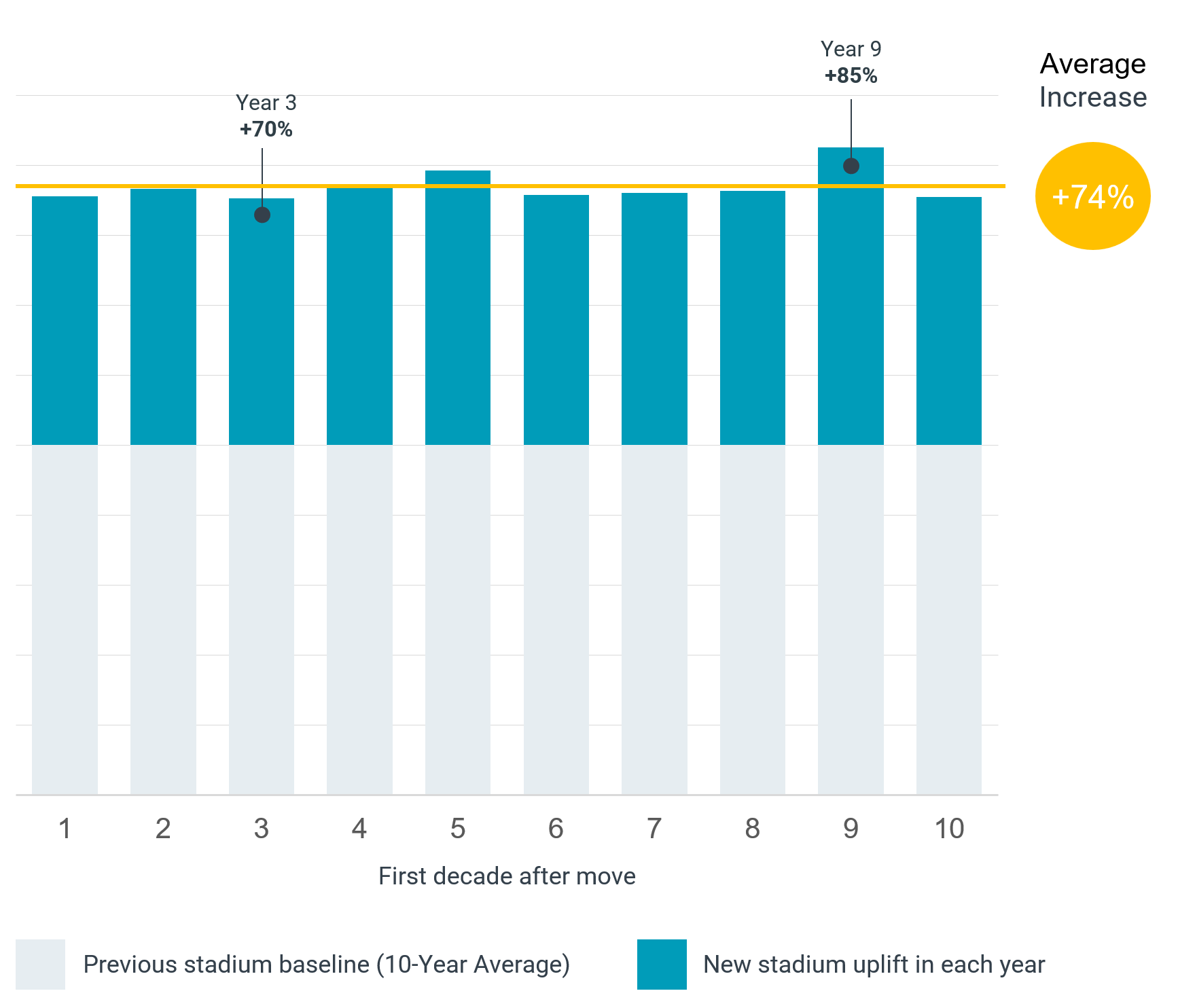
The consistency of these gains points to a fundamental re-basing of demand, a pattern consistent with many clubs expanding their audience into previously under-served segments—families, hospitality and premium experiences—while converting casual attendees into regulars.
Structural constraints were a defining feature of many English grounds by the early 1990s. Venues offered limited comfort, poor sightlines and restricted – often retrofitted – hospitality provision, capping both attendance and revenue potential.
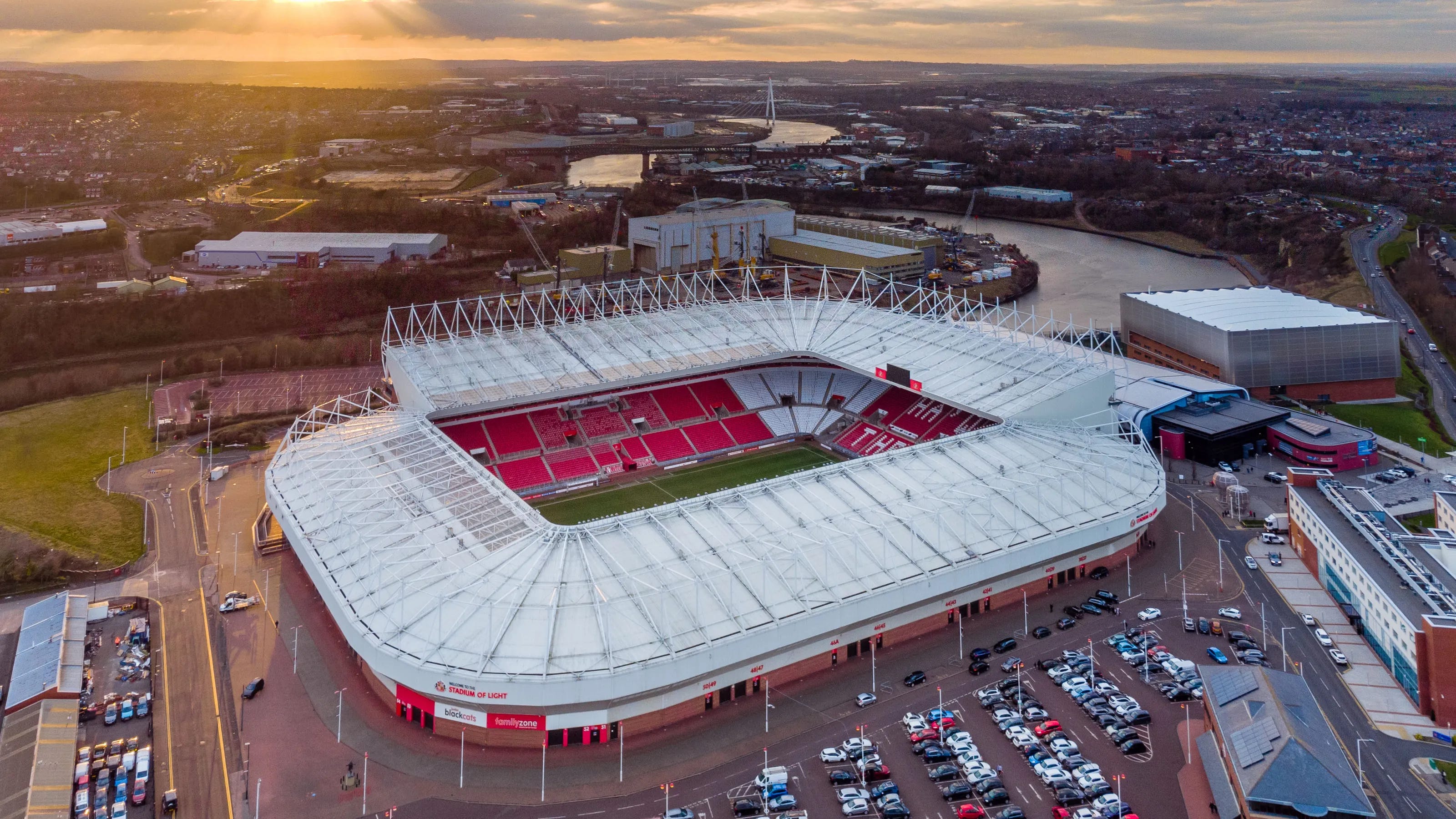
Relocation removed these constraints. Early movers such as Middlesbrough, Derby County, Sunderland and Southampton demonstrated the effect clearly, each delivering step-change increases in attendance—around 90% on average—showing how latent demand, once unconstrained, converts into sustained growth.
#2 Almost all clubs saw attendance growth
Attendance growth occurred in all but two clubs. Of the 24 that increased, nearly one-third more than doubled their pre-move support, and most delivering gains more than 50%.
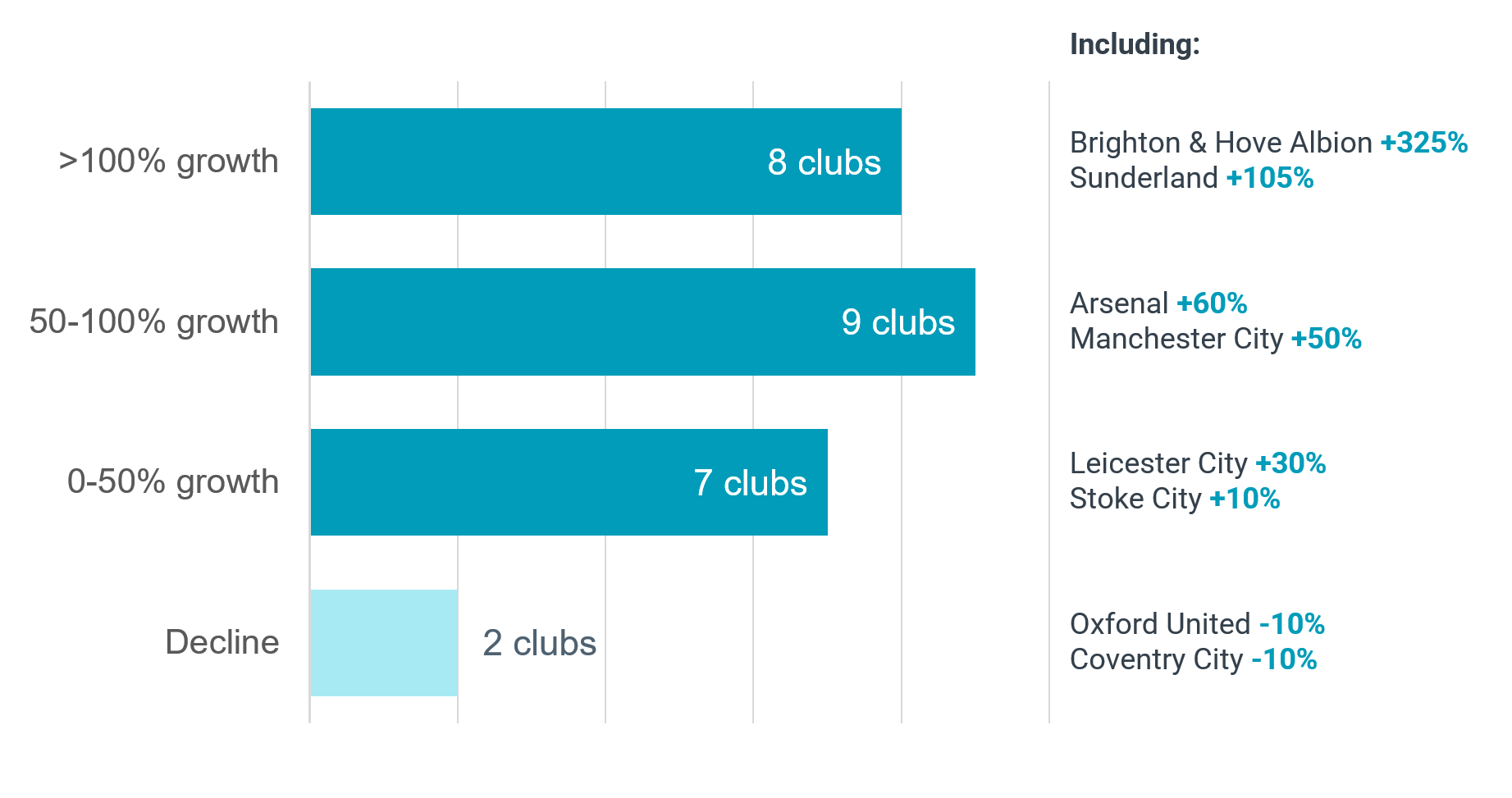
Strong performance is seen across a wide range of contexts – stadium constraints and occupancy, fanbase profile, league level and on-pitch performance – except at capacities of 10,000 or below, where growth is typically closer to 30%.
Crucially, downside is limited. Declines are rare and modest – seen only at Oxford United and Coventry City – while gains are substantial, indicating a consistently favourable revenue risk profile, prior to financing and capital costs.
#3 Occupancy is a poor proxy for demand
Half of clubs operated below 50% capacity prior to their stadium move, yet growth remained strong, with no meaningful relationship between occupancy and subsequent uplift.
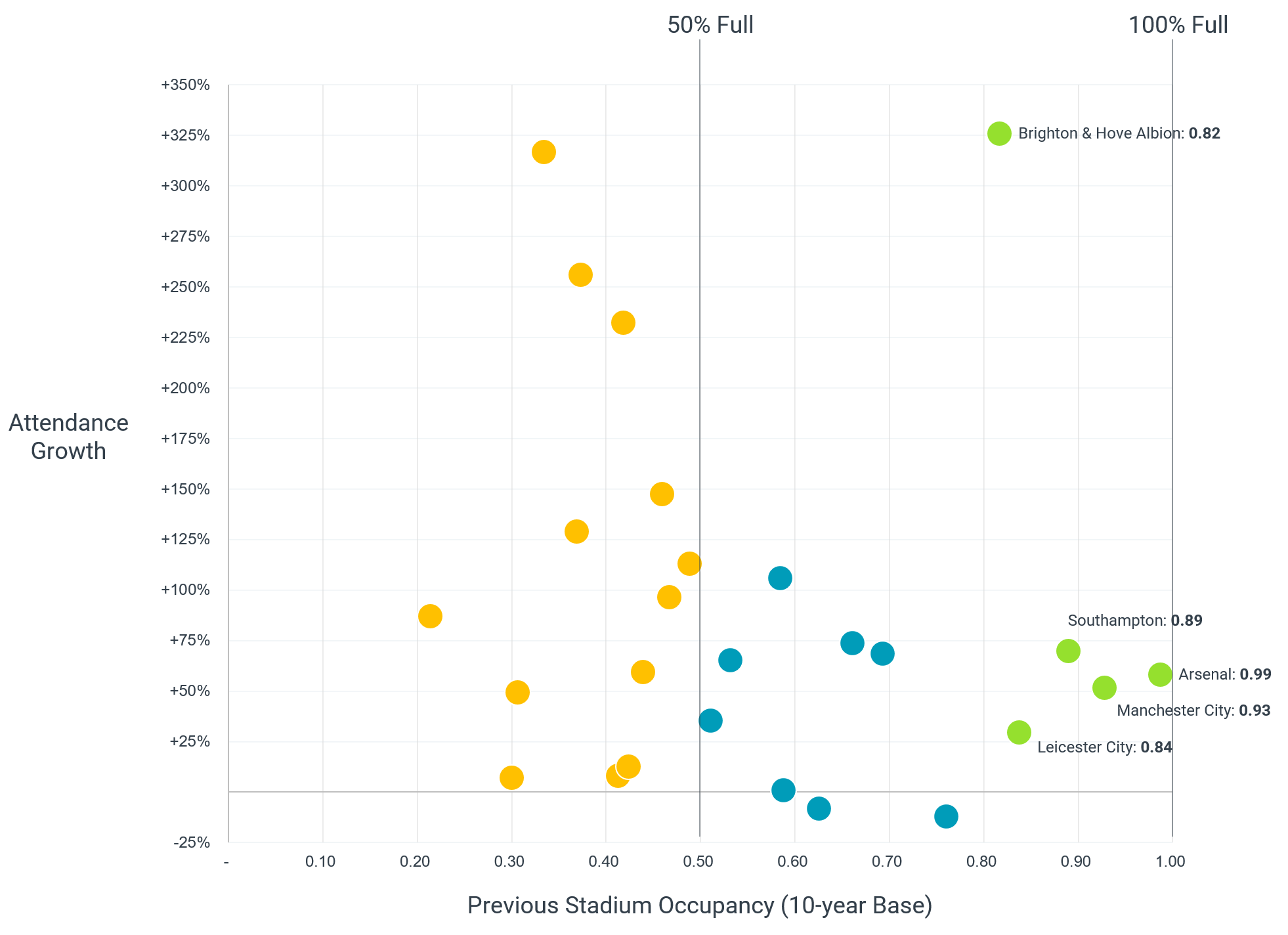
Only five clubs—Arsenal, Manchester City, Southampton, Leicester City and Brighton & Hove Albion—exceeded 80% occupancy at their previous stadiums, but there was no consistent relationship between this high occupancy and subsequent growth.
Fundamentally, pre-move occupancy captures only part of a club’s true demand—an existing core audience—and materially understates demand suppressed by stadium quality and matchday experience.
#4 Attendance growth remained strong after 20 years
Attendance growth is sustained into the second decade, with 15 clubs delivering an average uplift of 91% in years 11 to 20, and 84% over the full 20-year period.
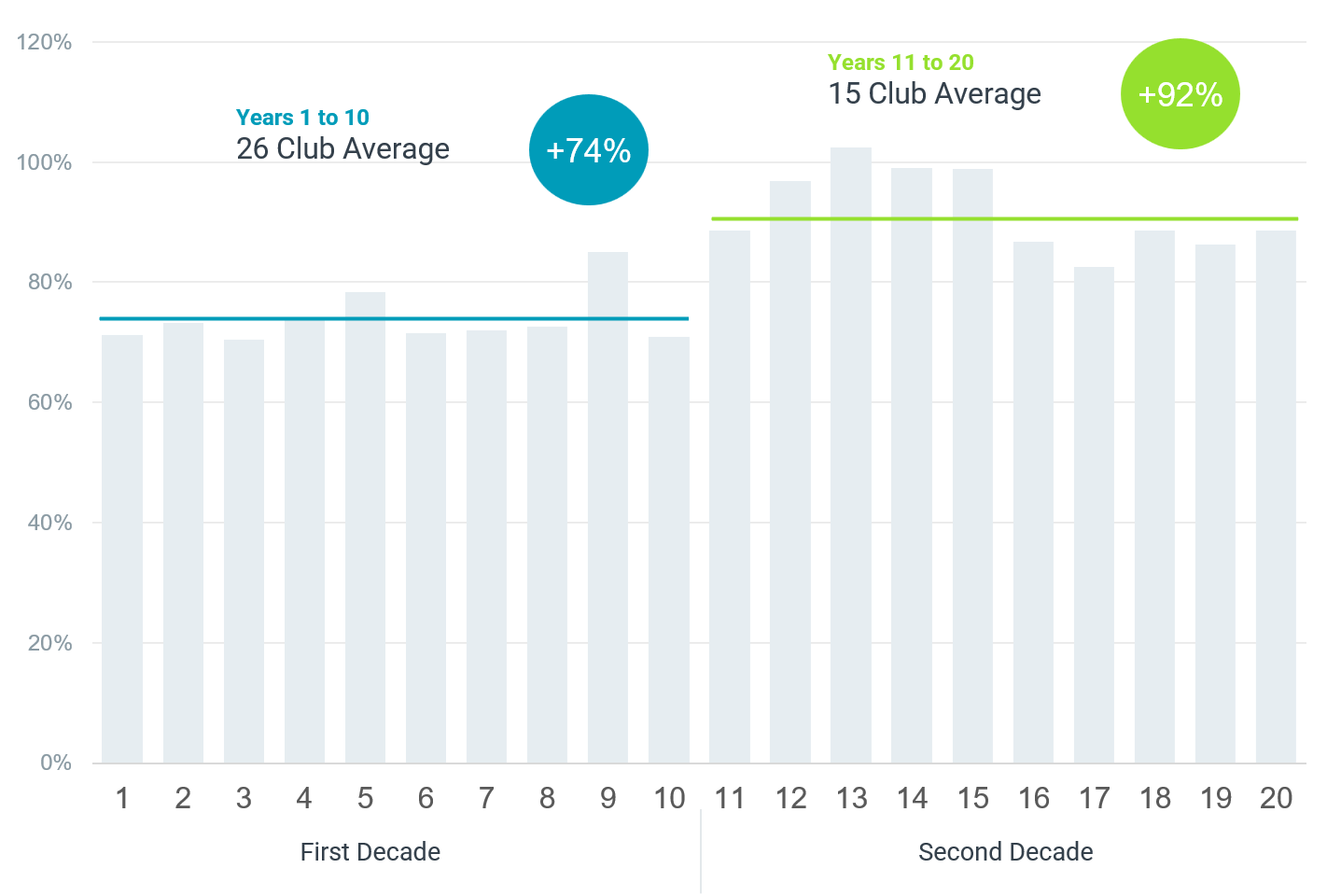
Outcomes remain consistently strong: 13 of the 15 clubs recorded growth of more than 45% over 20 years, including Manchester City, Sunderland, Middlesbrough, Derby County, Southampton and Leicester City.
Initial gains are not reversed, with clubs operating within a new elevated range and no evidence of decline as stadiums mature—indicating that gains are durable, persist across multiple competitive and economic cycles, and align with the long-term life of the stadium asset, rather than dissipating after the initial years.
#5 Growth in the second decade matched the first, even after adjusting for market trends.
New stadiums deliver significant growth, but this occurs alongside broader increases in attendance across the game.
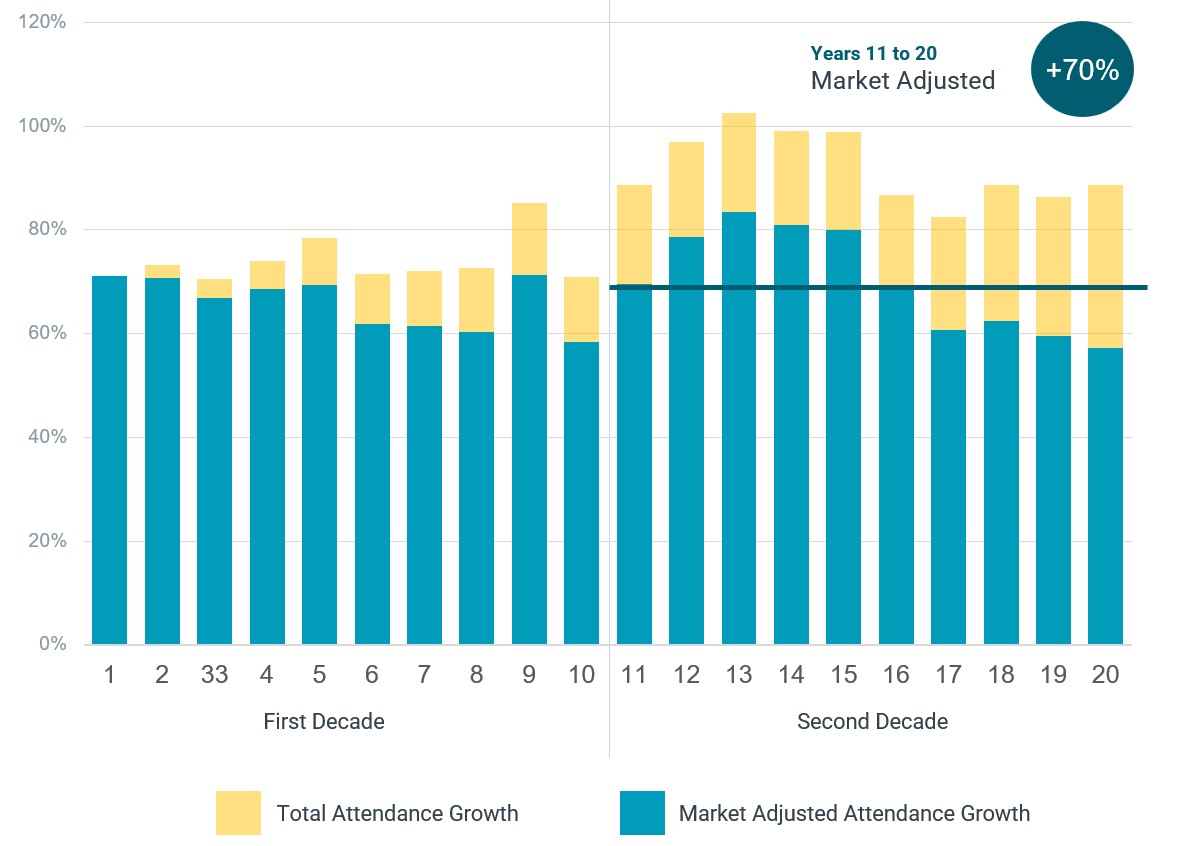
Market-adjusted growth remains strong at c.70% in the second decade—indicating that the uplift is not driven by wider industry trends, including capacity increases through redevelopment and rising overall demand for football in England.
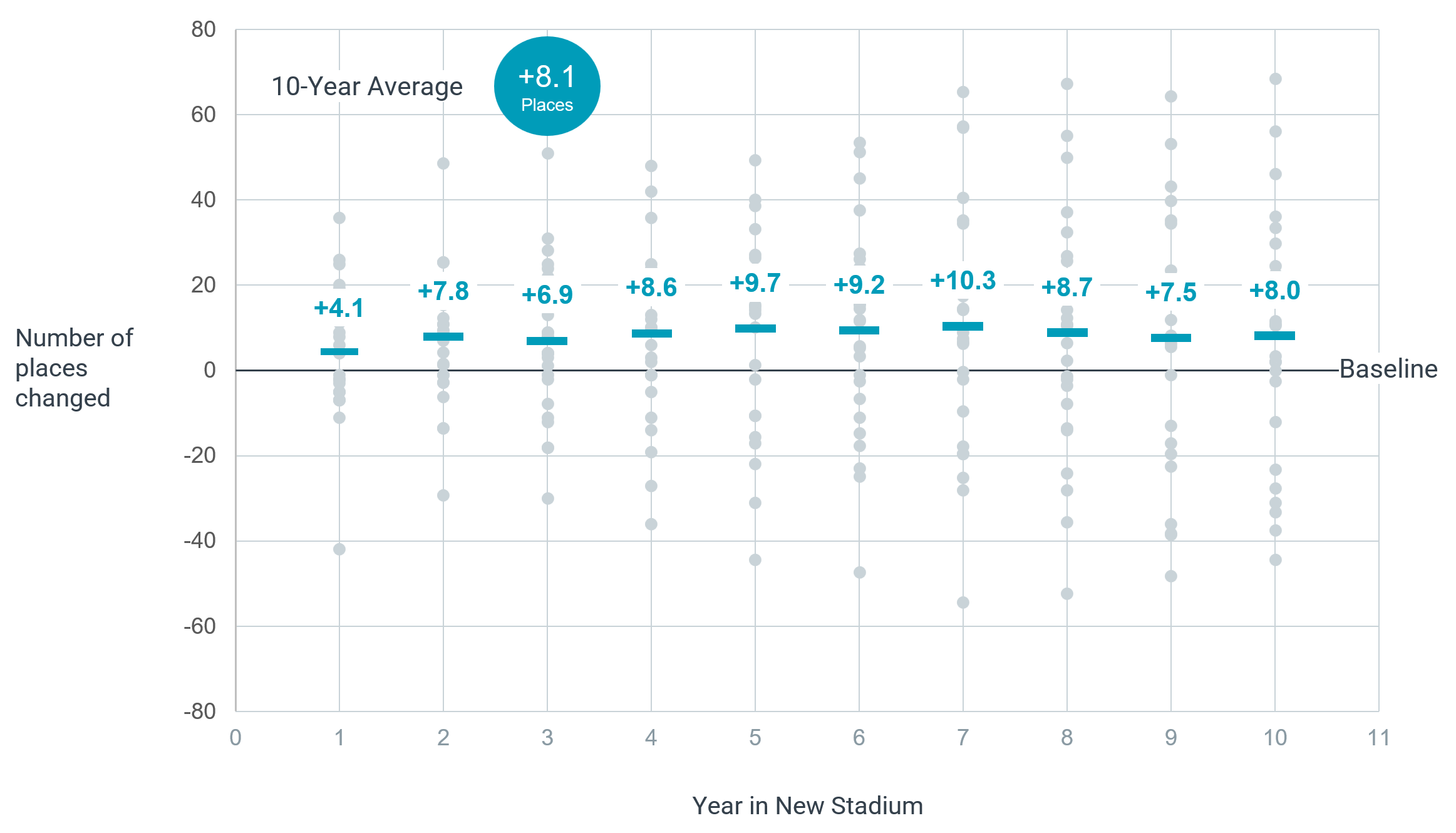
#6 Clubs improve by an average of eight league places following a stadium move
In the first ten years after a stadium move, clubs improved by an average of eight league places relative to the preceding decade.
Outcomes are more variable than attendance, reflecting the inherent volatility of on-pitch performance. While 16 clubs improved relative to their previous base, 10 declined; across all 260 seasons measured, 65% in a new stadium exceeded the prior 10-year average, with 35% below it. The median club improved their position by 10 places.
Again, the pattern persists beyond the first decade. Across 20 years, 12 of 15 clubs improved relative to their performance base, averaging an 11-place improvement in years 11 to 20—equivalent to nearly half a division.
The performance impact stadiums can drive is illustrated by Wigan Athletic, Hull City, Swansea City and Brighton & Hove Albion. Across the 40 seasons prior to relocation, only three were played in the second tier (all by Brighton), with the remaining 37 in the third and fourth tiers. All four clubs came within three places of relegation to non-league football before their move, but within six years all had reached the Premier League.
On-pitch performance is influenced by a broader and more volatile set of variables than attendance, including ownership strategy and investment, recruitment quality, executive decision-making, and the effectiveness of football operations. League dynamics, managerial performance, and timing effects further shape outcomes, introducing variability that sits outside the direct impact of stadium development.
Conclusion
New stadiums in English football consistently deliver a structural re-basing of demand, resulting in large, sustained increases in attendance across a wide range of club contexts. These effects are not transient, nor are they explained by broader market growth—supporting the findings of Van Ours and contrasting with US-based studies that characterise stadium effects as short-lived.
As such, a new stadium is best understood not as a short-term uplift, but as a long-life enabling asset that shifts a club’s operating range, revenue base, and long-term trajectory.
Stadiums expand a club’s competitive range and increase the likelihood of improved outcomes, but do not guarantee them.
Great Article
Be interesting to see the effects of the Sports Quarter & New Stadiums training facilities & all other venues on the growth of Birmingham City
And how it affects other clubs in the area
It's about time Birmingham City had proper owners with the vision for one of the last if not the last sleeping giants
I really enjoyed reading this. I’m currently finalising a short preprint about Everton Women and their move to Goodison Park. It’s more a heritage piece than statistics but really enjoyed reading this.